How To Remain Human
When harm is constant and unresolved

Welcome to Backward Facing Therapy, where you’ll find soulful stories and grounded insights from both sides of the therapy couch, plus practical tools to care for your mind in everyday life.
Paid subscribers unlock Kim’s Therapy Space, where I share downloadable workbooks, worksheets, and journals to support your journey. You also gain access to the Course Vault.
Please note: This information is provided for educational purposes only and should not be used as a substitute for professional healthcare advice.
There is a particular kind of exhaustion that comes from watching harm unfold in public and being told (implicitly or explicitly) that this is normal now.
Watching immigrant families being separated, chased, and demonized.
Watching people being detained or disappearing into systems with little transparency.
Watching cruelty framed as policy, and indifference framed as pragmatism.
Watching leaders speak with admiration for domination, punishment, and unchecked power.
And then watching how quickly people acclimate.

If you feel disoriented, grief-stricken, angry, numb, or strangely detached, there is nothing wrong with you. Those reactions are not overreactions. It’s your nervous system responding to real human suffering without resolution.
I’m a trained therapist armed with a wealth of therapeutic tools, but even I have swung between anger, grief, and feeling numb in the past few months.
I can only imagine how those of you without my training are feeling.
This essay may not heal your wounds, but I hope it at least lets you know you are seen.
Research on trauma exposure shows that witnessing cruelty, even indirectly, can produce real psychological injury, especially when the harm is ongoing and unresolved (Judith Herman, 1992).
This distress is not a sign of fragility but a predictable response to sustained exposure to human suffering without repair or accountability. When a threat (or threats) is chronic, the nervous system adapts instead of recovering. This adaptation often shows up as hypervigilance, emotional numbing, anger, despair, or dissociation (Source).
Research on continuous traumatic stress demonstrates that when there is no clear end to danger, people remain in a state of physiological readiness. The nervous system prioritizes survival over reflection, which affects our emotional capacity and perception of safety.
The idea of “continuous” traumatic stress is tied to the recognition that, for many citizens of the world today, trauma exposure is both current and to be realistically anticipated in the future, rather than being past or post. The distinguishing characteristics of CTS relate to its context, the temporal location of the stressor conditions, the complexity of discriminating between real and perceived or imagined threat, and the absence of external protective systems. Source
On the flip side, you may notice people who seem unmoved by cruelty, demonization of groups of people, or excessive force and violence. It’s easy to interpret that as indifference, but for some, it’s simply emotional overload. Emotional numbing is a common trauma response when pain is repeated, and control is limited.
In others, it’s called racism, xenophobia, white nationalism, and hatred. That’s not a mental health issue but a moral issue.
Scroll through any social media feed, and you’ll see people saying things like:
“I don’t recognize this country anymore.”
“I feel ashamed to call myself an American.”
“The system feels broken beyond repair.”
This is a result of people being forced to witness actions that violate their core values while lacking the power to stop them.
In psychology, this is called a moral injury (Source).
Moral injury is psychological harm incurred from committing, witnessing, or being subject to actions that violate one’s moral code…
And that grief that we’ve been feeling? It can appear even when the harm is not happening to us personally. Humans are wired to respond to others' suffering. Witnessing families ripped apart or lives treated as expendable activates grief because something essential is being lost: safety, dignity, shared moral ground.
When grief has no acknowledgment and no outlet, it does not disappear. It becomes exhaustion, bitterness, numbness, or despair.
So how do we stay human without breaking, hardening, numbing, or detaching?
Intentional witnessing:
choosing when and how you take in information
naming cruelty clearly without diminishing it
calling out gaslighting when we see it happening
processing reactions with other humans
allowing ourselves to feel and name the grief
taking small, values-aligned actions that restore/give a sense of purpose

You are allowed to protect your nervous system without surrendering your values. The goal is to remain human in conditions that make that difficult.
Note: This essay is not an argument for a party or platform. It is a trauma-informed analysis of what prolonged exposure to cruelty, dehumanization, and normalized harm does to the human nervous system and moral framework. The research behind this spans decades and applies across cultures and governments. Naming psychological impact is not ideology. Ignoring it does not create resilience. It only compounds injury.
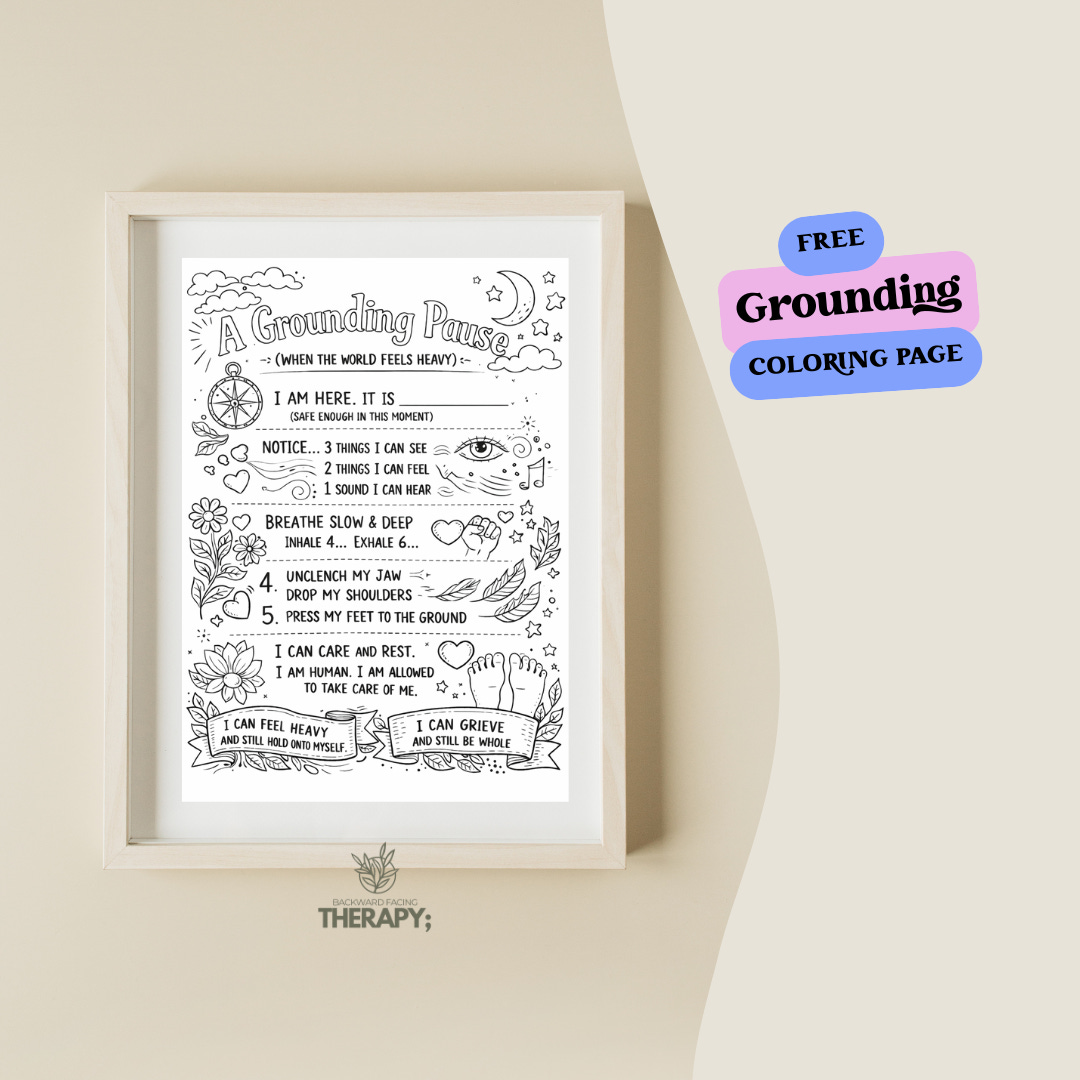
If you feel overwhelmed, angry, sad, or numb, let’s take a moment to do a grounding exercise.
Do this slowly:
Name where you are.
Say (out loud if possible):
“I am here. It is [day/time]. I am safe enough in this moment.”Orient your senses.
Look around and name:3 things you can see
2 things you can feel in your body
1 sound you can hear
Breathe low and slow.
Inhale through your nose for 4 seconds.
Exhale through your mouth for 6 seconds.
Repeat 4–5 times.Release what you’re holding.
Unclench your jaw.
Drop your shoulders.
Press your feet gently into the ground.Remind yourself:
“Witnessing harm affects me because I am human. I am allowed to take care of my nervous system.”
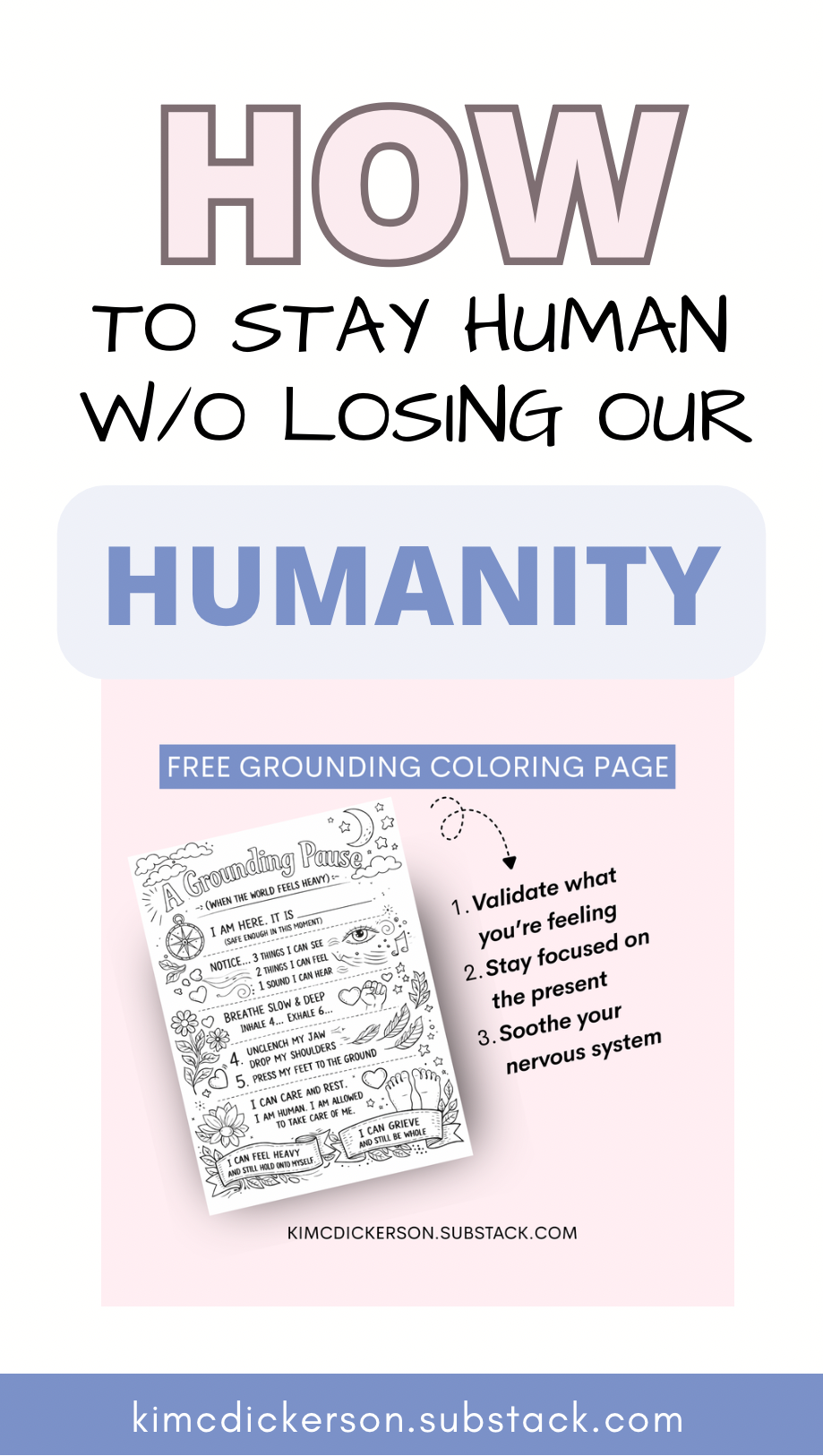
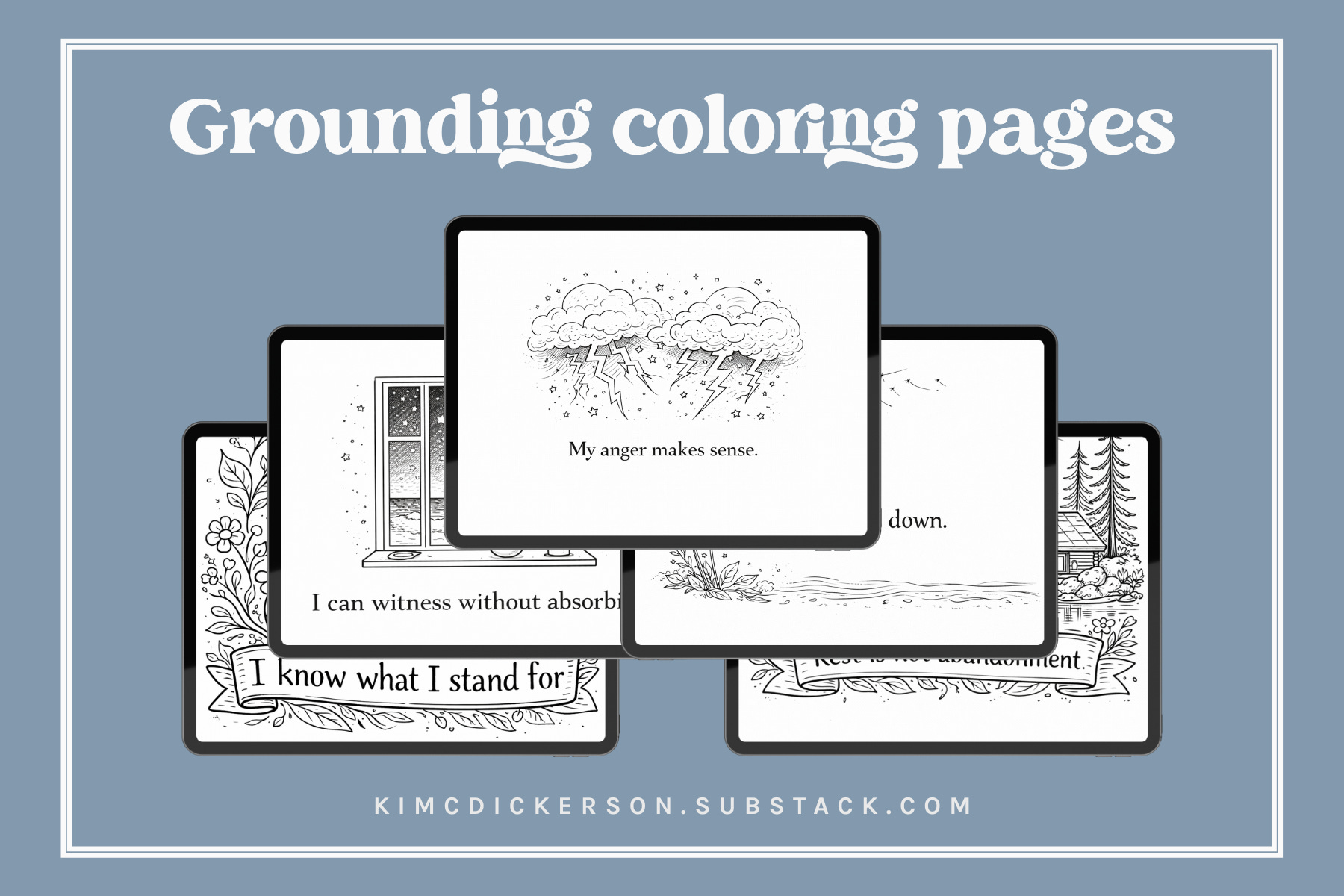
I’ve turned these grounding exercises into a one-page coloring page, and it’s my gift to you. Use regularly and often.

***Paid subscribers: Head to Kim’s Therapy Space, where five more pages of grounding coloring pages are available to download.
Before you go…
Creating these posts takes a significant amount of time, so if you appreciate them, becoming a paid subscriber is the best way to support my work.
You can also buy something for the feral, stray, and community cats I care for (I run a nonprofit cat rescue)
Shares, likes, and comments are also a way to show your support.
However you show up, I’m glad you’re here.
Please take good care of yourself,
Kim <3