
The Unreachable Generation
and the Gift of Resilience

Welcome to Backward Facing Therapy, where you’ll find soulful stories and grounded insights from both sides of the therapy couch, plus practical tools to care for your mind in everyday life.
Paid subscribers unlock Kim’s Therapy Space, where I share downloadable workbooks, worksheets, and journals to support your journey. You also gain access to the Course Vault.
Please note: This information is provided for educational purposes only and should not be used as a substitute for professional healthcare advice.
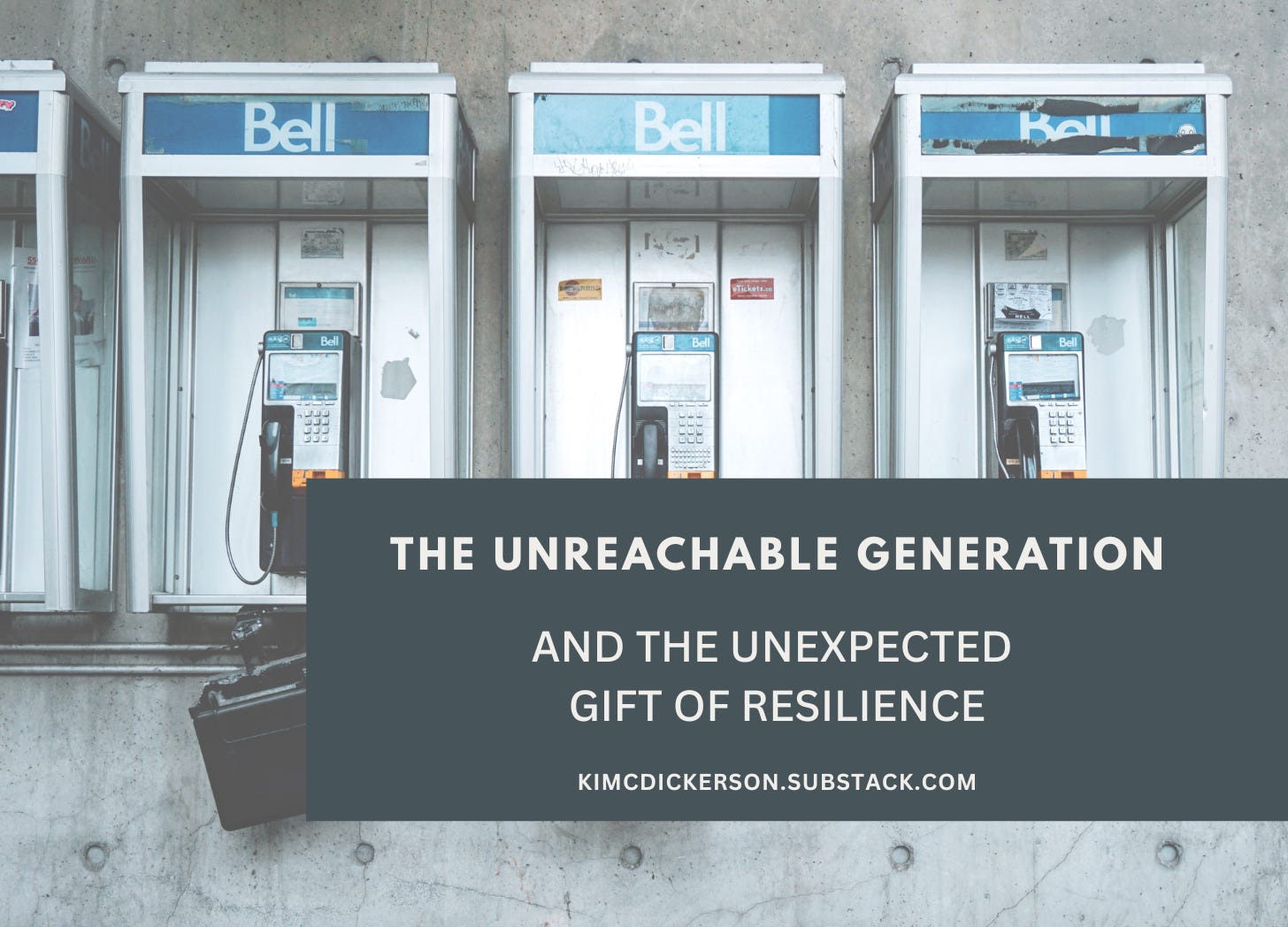
I was recently listening to a 1980’s Top 40 countdown on the radio, and the voice of one of the “original MTV veejays” took me to a place I’d already been lingering.
A place where real friendships existed in person or not at all. A place where newspaper stands lined the streets, and phone booths stood tall. A place where arguments were hashed out on the playground or in school and settled by the time the bell rang.
A place of wire hangers on TV’s, cups of Kool Aid with your friends, and parents were often absent.
We were the unsupervised generation. The analog generation. The unreachable ones.
While the 80s weren’t perfect, I was thinking about how the experience of it prepared me for the future.
When my mom sent me across the street to the grocery store with a bag full of change and a list, I had to figure out how to buy the items on the list with the money in the plastic baggie. I had to decide which items to put back and which were a must while calculating tax. I problem-solved in real time while navigating the risk of being a nine-year-old alone in a grocery store.

While there was nothing idyllic about this, the repeated exposure to uncertainty taught me that “I can handle this.” The repeated experiences of uncertainty and problem-solving gave me a strong foundation for navigating life.
Every 80’s kid knew that you didn’t dare tell your parents you were bored because the response was usually, “I’ll find you something to do.” That something usually involved cleaning or helping out around the house, so I learned to keep my boredom to myself.
During the downtime, I arranged my cassette tapes, read a Nancy Drew book again, or pored through the Sunday newspaper. While it might’ve felt boring back then, this time allowed me to daydream, problem-solve, and think about things that happened at school.
This boredom helped build my ability to self-engage and to imagine. I don’t need social media to ramp up my dopamine. I can do that all by myself. ;)
When disagreements happened, they were dealt with in real life. No one posted screenshots of chats, doxxed you, or digitally altered your photos so you appeared nude.
And during the times someone was mad at me? I didn’t just pay attention to their voice. I scanned their body language and emotions, and I learned how to read faces, detect social cues, and gauge tone.
I didn’t know it then, but those experiences were my first real-life lessons in conflict resolution and building social resilience.
Today, it means that I don’t care what others think of me, and I’ve learned how to let negativity roll right over me. It means I can diffuse tense situations and I don’t panic in crises.
While the kids of today experience many things through technology, we, the children of the 1980’s, lived our experiences.
I climbed trees, scraped my knees, got dirty, drank hose water, and played tag for hours. We made M*A*S*H fortune tellers outdoors, danced to whatever was on the radio, and investigated insects up close.
It was a perfect escape from a childhood where I often felt unseen, unloved, and neglected. These lived experiences (with friends) helped me feel less alone, understood, and cared for.
It was also nice to get a bag of chips or a popsicle from a friend’s mom since these items were seldom in our grocery budget.
Do you know that part of The Shawshank Redemption where Andy manages to get beers for his “coworkers” and they’re sitting on the roof drinking them, enjoying the view, and for a brief period, their lives feel normal?
Yep. That’s how I felt with those chips and popsicles.
This time with friends wasn’t just a meaningful part of my socioemotional development. Honestly, it was much more than that. What I learned, what I experienced, and what I navigated became part of my core being.
Resilience isn’t just cognitive, it’s physiological.
Now, don’t get me wrong, I’m not romanticizing the hands-off, unsupervised, latchkey style parenting of this time period. I’m simply looking at how we, the unreachable generation, were given room to breathe and grow on our own.
Our every movement wasn’t tracked or filmed, boredom wasn’t a thing for technology to solve, and conflict was settled by the end of the day.
My resilience that I have today wasn’t because I was protected from stress. It’s because I was in situations where I had to problem-solve without adult intervention.
It may not have been the healthiest way to learn, but my nervous system knows that conflicts, missteps, embarrassment, and boredom are survivable.
We, the kids of the 1980’s, the last unsupervised generation, somehow turned out alright.
Now let me go MacGyver something…
References
Masten, A. S. (2001). Ordinary magic: Resilience processes in development. American Psychologist.
Gray, P. (2011). The decline of play and the rise of psychopathology in children and adolescents. American Journal of Play.
Raichle, M. E. et al. (2001). A default mode of brain function. Proceedings of the National Academy of Sciences.
Before you go…
Creating these posts takes a significant amount of time, so if you appreciate them, becoming a paid subscriber is the best way to support my work.
Shares, likes, and comments are also appreciated.
However you show up, I’m glad you’re here.
Please take good care of yourself,
Kim <3
You May Also Like:


Drinking out of hoses. 😂 We didn’t just investigate insects - we burned them with matches! I think you’re right. Life was a natural laboratory, and experimentation built mindsets that may be lacking in future generations.
Kim, my childhood in general might have been different in Germany, yet almost all of what you wrote about the 80s (well in my case the 70s too) is something I can relate to.